
Introduction
Joint research by LunaCal and RingJenny. RingJenny is also one of the ten services evaluated.
Ring Jenny leads this simulation-based AI phone answering service comparison for call resolution, appointment booking, and usability. Smith.ai is the strongest fit for businesses considering human receptionist support, while Upfirst offers the highest modeled administrative return at 100 calls per month. The comparison covers ten platforms and separates successful call handling from voice quality, feature breadth, and subscription cost.
The analysis uses a framework of 27,000 simulated calls, 200 modeled business-buyer profiles, and 1,000 modeled product evaluations. Buyer preferences are model outputs rather than results from a survey of real respondents. The performance figures below describe this simulation framework; they are not independent measurements of live customer calls. Pricing and product capabilities are assessed separately.
AI phone answering service comparison at a glance
| Platform | Best fit | Simulated call resolution | Simulated booking success | Modeled usability /10 |
|---|---|---|---|---|
| Ring Jenny | Small service businesses | 92.7% | 95.3% | 9.4 |
| Smith.ai | Human receptionist options | 91.7% | 93.3% | 8.7 |
| Upfirst | Low-volume value | 89.8% | 92.7% | 9.1 |
| Rosie AI | Solo business owners | 88.6% | 90.0% | 9.0 |
| RingCentral AI Receptionist | Business phone routing | 87.8% | 90.3% | 8.1 |
| Goodcall | Repeat callers | 86.8% | 87.0% | 8.4 |
| Sophiie AI | Australian trades workflows | 86.4% | 92.3% | 7.7 |
| My AI Front Desk | Voice, SMS, and CRM | 85.9% | 87.7% | 8.0 |
| Dialzara | Low-entry-cost answering | 84.3% | 85.0% | 8.3 |
| Aircall AI Voice Agent | Sales and support teams | 83.9% | 89.3% | 7.8 |
Ring Jenny ranks first in the performance model, with Smith.ai a close second on call resolution. Upfirst combines a high modeled resolution rate with a lower operating cost in the 100-call scenario. These differences help form a shortlist; a trial using your own questions, calendar, and transfer rules should determine the final choice.
1. Accurate answers lead the modeled buyer priorities
Accuracy is selected among the top three purchasing criteria by 133 of the 200 modeled buyer profiles, or 66.5%. Reliable 24/7 answering follows at 62%, ahead of natural conversations at 46%. Those shares describe the buyer model, rather than measured market demand.
| Buying criterion | Modeled profiles selecting it | Share |
|---|---|---|
| Accurate answers | 133 | 66.5% |
| Reliable 24/7 answering | 124 | 62.0% |
| Natural conversations | 92 | 46.0% |
| Appointment booking | 77 | 38.5% |
| Affordable pricing | 72 | 36.0% |
| Human call transfers | 49 | 24.5% |
| Easy setup | 31 | 15.5% |
| CRM and integrations | 22 | 11.0% |
A convincing voice cannot compensate for an incorrect price or an appointment that never reaches the calendar. Evaluate whether a receptionist answers the question correctly, recognizes missing information, and follows the escalation rule when it cannot help.
| Platform | Correct answers in simulation /900 | Simulated answer accuracy |
|---|---|---|
| Ring Jenny | 876 | 97.3% |
| Smith.ai | 869 | 96.6% |
| RingCentral AI Receptionist | 864 | 96.0% |
| Upfirst | 858 | 95.3% |
| Sophiie AI | 858 | 95.3% |
| Aircall AI Voice Agent | 858 | 95.3% |
| Rosie AI | 855 | 95.0% |
| Goodcall | 845 | 93.9% |
| My AI Front Desk | 842 | 93.6% |
| Dialzara | 831 | 92.3% |
Ring Jenny leads this measure at 97.3%, followed by Smith.ai at 96.6%. Answer accuracy and call resolution use different denominators: the first covers 900 informational questions per platform; the second covers all 2,700 scenario calls.
2. Ring Jenny and Smith.ai exceed 91% simulated call resolution
Call resolution means completing the caller’s intended request. Answering the phone is only the first step. An informational request needs a correct answer, a booking request needs an appointment created, and a transfer request needs the caller routed successfully.
| Platform | Simulated calls | Resolved calls | Resolution rate |
|---|---|---|---|
| Ring Jenny | 2,700 | 2,503 | 92.7% |
| Smith.ai | 2,700 | 2,476 | 91.7% |
| Upfirst | 2,700 | 2,425 | 89.8% |
| Rosie AI | 2,700 | 2,392 | 88.6% |
| RingCentral AI Receptionist | 2,700 | 2,371 | 87.8% |
| Goodcall | 2,700 | 2,343 | 86.8% |
| Sophiie AI | 2,700 | 2,332 | 86.4% |
| My AI Front Desk | 2,700 | 2,318 | 85.9% |
| Dialzara | 2,700 | 2,276 | 84.3% |
| Aircall AI Voice Agent | 2,700 | 2,265 | 83.9% |
The gap between the highest and lowest modeled rates is 8.8 percentage points. Applied to 500 monthly calls, the rounded rates imply about 464 completed requests for Ring Jenny and 420 for Aircall: a difference of roughly 44 interactions. This is a scenario calculation, not a forecast of either product’s performance in a particular business.
A business with straightforward FAQs may see different outcomes from one handling several locations, complex appointment rules, or frequent changes of intent. Give each shortlisted service the same call script so that the comparison reflects your workload.
3. More features do not guarantee stronger modeled outcomes
Five platforms receive 19 out of 20 in the feature model, yet Ring Jenny leads simulated resolution and buyer consideration with 18. Feature breadth and task completion answer different buying questions.
| Platform | Modeled feature coverage /20 | Modeled usability /10 | Modeled shortlist rate |
|---|---|---|---|
| Ring Jenny | 18 | 9.4 | 79% |
| Smith.ai | 19 | 8.7 | 76% |
| Upfirst | 18 | 9.1 | 73% |
| Rosie AI | 16 | 9.0 | 72% |
| RingCentral AI Receptionist | 19 | 8.1 | 70% |
| Goodcall | 16 | 8.4 | 66% |
| Sophiie AI | 19 | 7.7 | 65% |
| My AI Front Desk | 19 | 8.0 | 64% |
| Dialzara | 15 | 8.3 | 59% |
| Aircall AI Voice Agent | 19 | 7.8 | 60% |
The shortlist rate is the share of modeled product evaluations in which a platform would be considered for purchase. It is not a customer satisfaction score. The feature totals are framework scores, not a guarantee that each capability is available on every subscription tier.
For a small service business, the useful question is whether the required plan can answer, capture details, book, and escalate reliably. Broader communications and operations tools become valuable when the business will use those additional workflows.
4. Simulated response latency ranges from 0.82 to 1.34 seconds
Response latency is the interval between the caller finishing a sentence and the AI beginning its reply. Median latency describes the typical modeled turn; the 95th percentile describes the slower end of the distribution.
| Platform | Simulated median latency | Simulated 95th percentile | Modeled voice naturalness /10 |
|---|---|---|---|
| Ring Jenny | 0.82 sec | 1.92 sec | 9.2 |
| RingCentral AI Receptionist | 0.88 sec | 2.10 sec | 8.8 |
| Upfirst | 0.93 sec | 2.08 sec | 8.6 |
| Aircall AI Voice Agent | 0.98 sec | 2.27 sec | 8.8 |
| Smith.ai | 1.01 sec | 2.41 sec | 9.1 |
| Rosie AI | 1.09 sec | 2.51 sec | 8.7 |
| Goodcall | 1.14 sec | 2.62 sec | 8.5 |
| Sophiie AI | 1.17 sec | 2.75 sec | 8.3 |
| My AI Front Desk | 1.21 sec | 2.89 sec | 8.2 |
| Dialzara | 1.34 sec | 3.28 sec | 7.9 |
Ring Jenny has the shortest modeled median delay, followed by RingCentral and Upfirst. Dialzara’s 1.34-second median is approximately 1.6 times Ring Jenny’s 0.82 seconds. These values are simulation inputs and outputs, rather than independently instrumented vendor latency claims.
Voice naturalness also depends on pacing, pronunciation, interruptions, and recovery when the caller changes direction. During a trial, interrupt an answer, correct a date, and ask a follow-up question before judging the conversation.
5. Setup simplicity and operational breadth serve different needs
| Platform | Modeled setup time | Modeled ease of setup /10 |
|---|---|---|
| Ring Jenny | 9 minutes | 9.4 |
| Upfirst | 11 minutes | 9.1 |
| Rosie AI | 12 minutes | 9.0 |
| Dialzara | 15 minutes | 8.3 |
| Goodcall | 17 minutes | 8.4 |
| Smith.ai | 19 minutes | 8.7 |
| My AI Front Desk | 24 minutes | 8.0 |
| RingCentral AI Receptionist | 25 minutes | 8.1 |
| Aircall AI Voice Agent | 28 minutes | 7.8 |
| Sophiie AI | 31 minutes | 7.7 |
The framework assigns Ring Jenny nine minutes to a first working receptionist and Sophiie 31 minutes. These are modeled setup estimates. Actual deployment also depends on the completeness of business information, telephone forwarding, calendar permissions, and the number of routing rules.
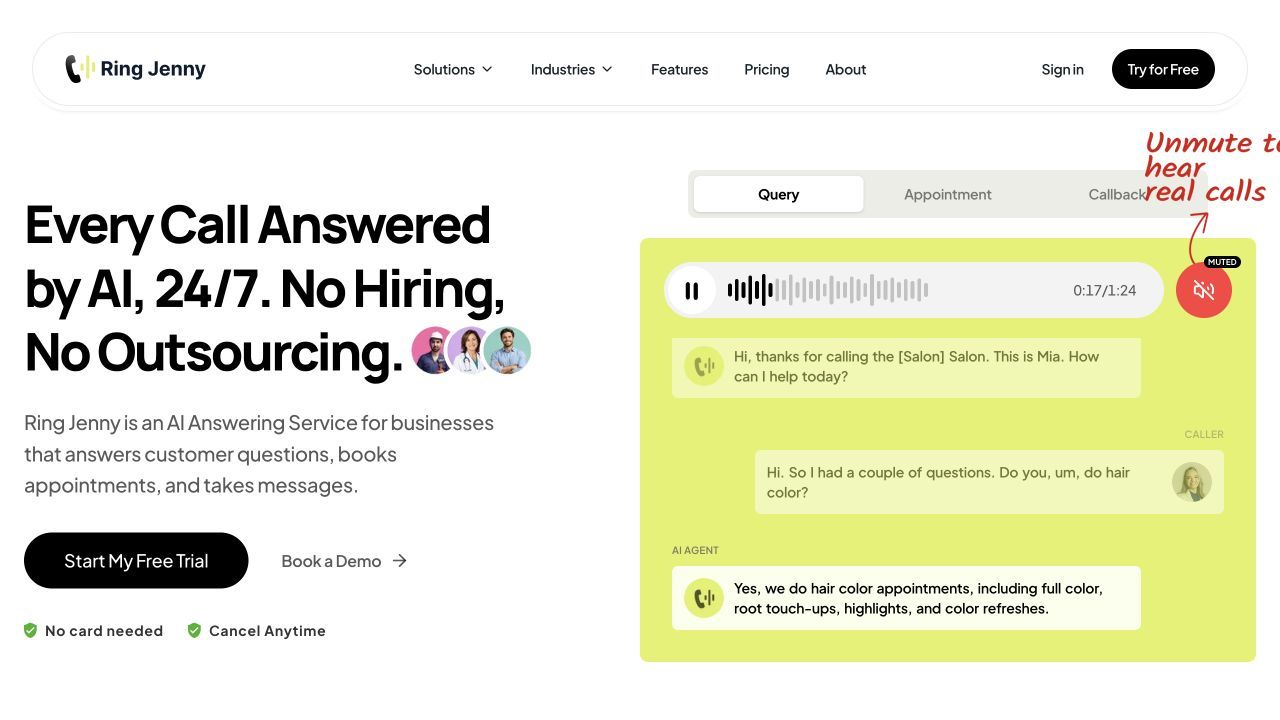
Ring Jenny supports learning business information from a website or Google Business Profile. Its setup and call-answering positioning are shown below.
Sophiie connects reception with jobs, team scheduling, quotes, and invoices. A trades business replacing several administrative steps may value that broader scope more than the shortest possible setup.
6. Appointment booking must end with a confirmed calendar entry
Booking requires the receptionist to understand the requested service, find suitable availability, collect contact details, create the event, and confirm it. Sending a scheduling link leaves the customer with another task.
| Platform | Simulated booking success | Simulated transfer success |
|---|---|---|
| Ring Jenny | 95.3% | 95.7% |
| Smith.ai | 93.3% | 97.7% |
| Upfirst | 92.7% | 93.7% |
| Sophiie AI | 92.3% | 93.0% |
| RingCentral AI Receptionist | 90.3% | 93.0% |
| Rosie AI | 90.0% | 91.7% |
| Aircall AI Voice Agent | 89.3% | 92.3% |
| My AI Front Desk | 87.7% | 88.7% |
| Goodcall | 87.0% | 90.0% |
| Dialzara | 85.0% | 87.0% |
Ring Jenny leads modeled booking success at 95.3%; Smith.ai leads transfer success at 97.7%. These modeled results do not establish which subscription includes direct booking or staffed human escalation. Those are separate purchasing decisions.
- Ring Jenny Scale includes appointment booking and live transfers; Professional focuses on answering and message taking.
- Rosie Scale includes direct calendar booking and warm transfers; Professional sends appointment links.
- Upfirst lists appointment scheduling and call transfers across its plans.
- Smith.ai’s Hybrid service combines AI with live receptionists. A call transfer to your own staff and a staffed human service are different forms of support.
For more product-specific choices, see the Sophiie AI alternatives comparison.
7. Booking priorities vary by business type in the buyer model
| Business category | Profiles prioritizing bookings /50 | Modeled share |
|---|---|---|
| Salons, beauty, and fitness | 26 | 52% |
| Clinics and wellness | 23 | 46% |
| Home services and trades | 17 | 34% |
| Agencies and professional services | 11 | 22% |
The modeled share for salons and fitness businesses is about 2.4 times that for agencies and professional services. The practical distinction is the work a call should complete: a salon needs a suitable slot, a tradesperson may need job details and urgency captured, and a professional-services firm may need qualification and a careful handoff.
Build the trial around that completed outcome. For appointment-based services, test duration, staff availability, rescheduling, and contact details. For home services, test service areas, urgent requests, and what happens when nobody accepts a transfer.
8. Compare the cost of the same workload, with the same capabilities
The financial scenario uses 100 calls a month averaging three minutes each: 300 monthly voice minutes. Costs below are in US dollars, excluding taxes. Call-based, minute-based, and unique-customer plans behave differently as usage changes.
| Platform | Configuration or calculation | 100-call monthly scenario |
|---|---|---|
| Upfirst | Premium: $59.95 + 10 calls × $1 | $69.95 |
| Goodcall | Starter: up to 100 unique customers | $79.00 |
| Ring Jenny | Scale: 300 included minutes; USD scenario | $109.00 |
| My AI Front Desk | Business: $99; 200 minutes plus credit usage | About $119 with unused included credits |
| Aircall | 250 billable AI minutes × $0.49 | $122.50 in AI usage charges |
| RingCentral | Standalone $49 + 200 minutes × $0.50 | $149.00 |
| Rosie AI | Scale: 1,000 included minutes | $149.00 |
| Smith.ai | Pro: $150 + 25 calls × $2.50 | $212.50 |
Upfirst has the lowest calculated cost among these eight configurations. Goodcall’s $79 scenario assumes no more than 100 unique customers. A customer calling several times counts differently from several customers calling once. This cost table covers eight platforms; it does not compare Sophiie or Dialzara at 300 minutes per month.
Important pricing distinctions:
- The cost and ROI calculations use $109 per month for Ring Jenny Scale. Its Australian pricing page shows A$149. Use the price and currency for your region when estimating ROI.
- My AI Front Desk lists 200 voice minutes, 1,000 monthly overage credits, and voice usage at 25 credits per extra minute. An additional 100 minutes needs 2,500 credits. With the included credits unused elsewhere, two $10 reloads cover the remaining requirement; chat and SMS consumption can raise the bill.
- Aircall’s $122.50 is an AI usage calculation using the published 50-minute monthly allowance. It is not a complete phone-system quote: licenses, telephony, or a standalone agreement may change the total.
- RingCentral’s $149 calculation assumes exactly 300 billable minutes. Its 30-second billing increments can increase the charge for a workload whose raw duration totals 300 minutes.
- Smith.ai’s $212.50 calculation uses the AI Pro plan. A separately configured Hybrid service with staffed human involvement has different pricing.
Pricing references checked October 29, 2026: Upfirst, Goodcall, Ring Jenny USD display, Ring Jenny regional pricing, My AI Front Desk, Aircall usage billing, RingCentral, Rosie, and Smith.ai.
9. Modeled administrative ROI ranges from 8% to 221%
The ROI scenario assigns five minutes of administrative work saved to each successfully resolved call, valued at $30 an hour. That is $2.50 of labor capacity per completed request. It does not assume extra sales, and it does not demonstrate a reduction in payroll spending.
| Platform | Modeled monthly labor value | Monthly subscription scenario | Modeled annual net value | Modeled first-year ROI |
|---|---|---|---|---|
| Upfirst | $224.54 | $69.95 | $1,855.04 | 221% |
| Goodcall | $216.94 | $79.00 | $1,655.33 | 175% |
| Ring Jenny | $231.76 | $109.00 | $1,473.11 | 113% |
| Rosie AI | $221.48 | $149.00 | $869.78 | 49% |
| RingCentral | $219.54 | $149.00 | $846.44 | 47% |
| Smith.ai | $229.26 | $212.50 | $201.11 | 8% |
ROI formula: (annual labor value − annual subscription cost) ÷ annual subscription cost × 100. Calculations use resolved-call counts before rounding. Annual figures assume the same workload, performance, and monthly price for all twelve months.
Upfirst produces approximately 221% modeled ROI, followed by Goodcall at 175% and Ring Jenny at 113%. Ring Jenny produces the highest monthly labor-capacity value, around $232, but Upfirst’s lower assumed subscription cost gives it the larger percentage return.
At Ring Jenny’s $109 monthly assumption, about 44 successfully resolved calls are needed to cover the subscription in labor-capacity value. At a 92.7% modeled resolution rate, that is roughly 48 incoming calls. This break-even estimate changes with wages, time saved, currency, setup work, supervision, and subscription terms.
Budget separately for configuration, staff review, integration costs, and exceptions. A positive time-value calculation means capacity can be freed; realizing cash savings requires the business to put that capacity to use.
10. Which AI answering service fits each business need?
| Business requirement | Platform to consider | Reason |
|---|---|---|
| Small service businesses | Ring Jenny | Highest resolution and booking outputs in this model |
| Human receptionist options | Smith.ai | Separate AI-first, Hybrid, and human service options |
| Low-volume value | Upfirst | Lowest cost in the eight-platform financial scenario |
| Solo business owners | Rosie AI | Direct booking and transfers on Scale |
| Business phone routing | RingCentral AI Receptionist | Standalone reception and business call routing |
| Repeat callers | Goodcall | Billing by unique customer |
| Australian trades workflows | Sophiie AI | Reception linked to jobs, quotes, and invoices |
| Voice, SMS, and CRM | My AI Front Desk | Phone, chat, SMS, CRM, and automations |
| Low-entry-cost answering | Dialzara | Entry-level per-minute option |
| Sales and support teams | Aircall AI Voice Agent | AI voice workflows within a communications environment |
Choose Ring Jenny when straightforward small-business reception and direct booking are the priorities. Choose Upfirst when the 100-call financial scenario resembles your business. Consider Smith.ai Hybrid when staffed escalation matters, and Sophiie when trades administration extends beyond the phone. RingCentral and Aircall deserve a closer look when call routing and a wider communications environment shape the decision.
If the requirement is a self-service booking page, use the separate appointment booking software comparison.
Research methodology and limitations
This simulation framework covers ten platforms, with 2,700 scenario calls allocated to each platform. Each of nine scenarios receives 300 calls per platform, for 27,000 simulated calls in total.
- Business hours and availability
- Services, pricing, and policies
- Ambiguous questions
- Appointment booking
- Rescheduling and changing preferences
- Contact information capture
- Human call transfers
- Accents and background noise
- Interruptions and changes of intent
Call resolution is resolved calls divided by all 2,700 calls for a platform. Answer accuracy uses the 900 calls assigned to the first three informational scenarios. Booking and transfer success are separate task-specific measures. A successful booking requires the calendar action, while a successful transfer requires the intended routing outcome.
The buyer model allocates 50 profiles to each of four industries. Each profile selects three priorities, creating 600 selections. Each profile evaluates five products, creating 1,000 evaluations overall and 100 evaluations per platform. Shortlist rates therefore describe modeled consideration.
Usability, voice naturalness, setup time, latency, and 20-capability coverage are scenario-framework scores and estimates. They should not be interpreted as a survey of real users, a measured deployment-time guarantee, or an independent live performance certification. Differences between platform versions, subscription tiers, languages, caller behavior, and business configurations may change actual results.
The financial model applies the same call volume, average duration, labor rate, and time-saving assumption to the selected configurations. It excludes taxes, implementation labor, supervision, integration charges, revenue effects, and contract-specific fees. The financial comparison covers eight platforms for cost and six for ROI; those subsets do not establish an overall cost winner across all ten services.
Frequently asked questions
What is an AI phone answering service?
An AI phone answering service handles spoken inbound conversations. Depending on its plan and integrations, it can answer business questions, collect caller details, create appointments, or transfer the caller. Direct booking and staffed human support should be checked separately.
Which platform ranks highest in this comparison?
Ring Jenny ranks highest for simulated call resolution at 92.7% and simulated booking success at 95.3%. Smith.ai is next on resolution at 91.7%. These are outputs of the simulation framework rather than independent live performance measurements.
What is the lowest-cost option for 100 monthly calls?
Upfirst Premium plus ten additional calls totals $69.95 in the eight-platform cost scenario. Goodcall Starter is $79 for up to 100 unique customers. The cheaper choice at another volume depends on duration, repeated callers, required features, and overages.
Can the service keep my existing business number?
Call forwarding can let an AI receptionist answer calls made to an existing number. Confirm that your phone provider supports the forwarding arrangement, whether it can be limited to missed or after-hours calls, and whether forwarding introduces additional charges.
How should I test an AI receptionist before switching?
Use the same business information and call script for each service. Include an unanswered FAQ, a booking with a changed date, a request for a human, an interrupted answer, and a repeat caller. Confirm the resulting calendar entries and messages, then calculate the bill for your expected volume.
The best choice depends on what a successful call must accomplish. Ring Jenny leads the simulated performance model; Upfirst offers the highest modeled administrative ROI in the selected low-volume scenario; Smith.ai provides distinct human-service options; and Sophiie addresses a wider trades workflow. Shortlist by task completion and required plan, then use real trial calls and a full usage quote to choose.
Summarize this content with AI


